Showing posts with label museum visit. Show all posts

Sunday, 19 January 2014

Theory Reflections

Seeing as its a new year, we have a new theme to ponder on our ‘theory fun fridays’ (as I still like to call them!). With this change in mind, I can’t help thinking back to our lectures about ‘The Museum’ last term. The series has definitely raised many lasting questions for me about the role of the museum, and how curator’s inevitably shape the narrative of what we see in a gallery space through their display choices, how things are labelled, the objects that are included…and what is left out! I think Emmanuelle was definitely provoking us to feel cynical and to take on a questioning mindset when we visit exhibitions. At first I was a little unsure how to react- I didn’t want to ruin the enjoyment of going to museums to be inspired, explore and simply SEE by constantly looking at things through a skeptical, critical mindset. Some elements of the lectures just seemed so depressingly negative! But at the same time, it felt empowering to be encouraged to question the narratives we are presented with. To think: who has decided that this is the story I should see? Why have they told the story in this specific way? Does this mean I have the whole picture, or do I need to look further?  If the Museum’s role is to educate, then surely taking this inquisitive approach as a visitor allows us to become much more informed. By actively engaging with the narrative in the space, and consciously considering the curator’s choices, surely we can learn more, find deeper inspiration and ultimately actually enjoy the experience more than if we simply go to observe, passively accepting and quickly forget what we’ve really seen. The idea of ‘mining the museum’ is actually quite exciting! 


In light of this, I started reflecting again on an exhibition I recently went to: ‘Hello My name is Paul Smith’ at the Design Museum. I liked how the Curator’s hadn’t attempted to control and confine the visitor by restricting how you moved around the space. Although there were different themed areas in separate rooms, they surrounded one central ‘hallway’ filled with photos from Smith’s own personal collection. This meant that from the entrance, you could then access any area at any time. As a result it didn’t feel like a linear, set narrative was being forced on you- the visitor could chose the order of the story, and easily return to a space if they wanted to re-engage with the ideas being explored there. Rather than presenting an overly clean, simplified and sanitised story of Smith’s work, the exhibition covered his whole creative process. Some fashion exhibitions and retrospectives seem to focus primarily on displaying countless beautiful final outcomes, but here rooms were made into reconstructions of Smith’s messy office and studio, with only a small area dedicated to showing a selection of finished garments. I thought this worked to give much more of an interesting insight into the process behind Smith’s work. As a result, I felt I understood his finished pieces better, as we’d been given a view into the thinking, struggles and development that led up to it. 

In summary, a few mantras I'll take away from last term's theory are: be inquisitive, question things...and if a museum tries to control and confine you- attempt walking around the exhibition backwards just to defy their prescriptive narrative! 

Saturday, 14 December 2013

The Museum of Childhood

I had a great visit to the museum of childhood this week. 
When I walked in, the 'confiscation cabinets' display immediately reminded me of my Box Clever objects! Even the style of display echoes back to how my objects looked when I did my pop-up display in college at the start of the project- it made me laugh! Pocket sized, bright, plasticy and shiny, it's easy to see how such items might become distractions at school...
Display of items confiscated from children in primary school classrooms
at the Museum of Childhood
I was really fascinated by the little handwritten notes and folded, scrawled on bits of paper in the first cabinet. It brought back memories of how me and my friends used to pass secret, funny or sweet messages to each other under the table at school as well. When I  went back home, this idea inspired another paper cut stencil for my print block. I love the way kid's notes are a big jumble of words and phrases, with some bits crossed out and no worry of whether parts are upside-down or squished in. For my stencil, I cut out a jumble of words all relating to the objects in my box, and how they make me feel in this childish style. It'll be interesting to see the effect when layered up with other stencils and printed!
close up of scrawled note from Confiscation Cabinet (MoC)
my word-based stencil for screen printing next term
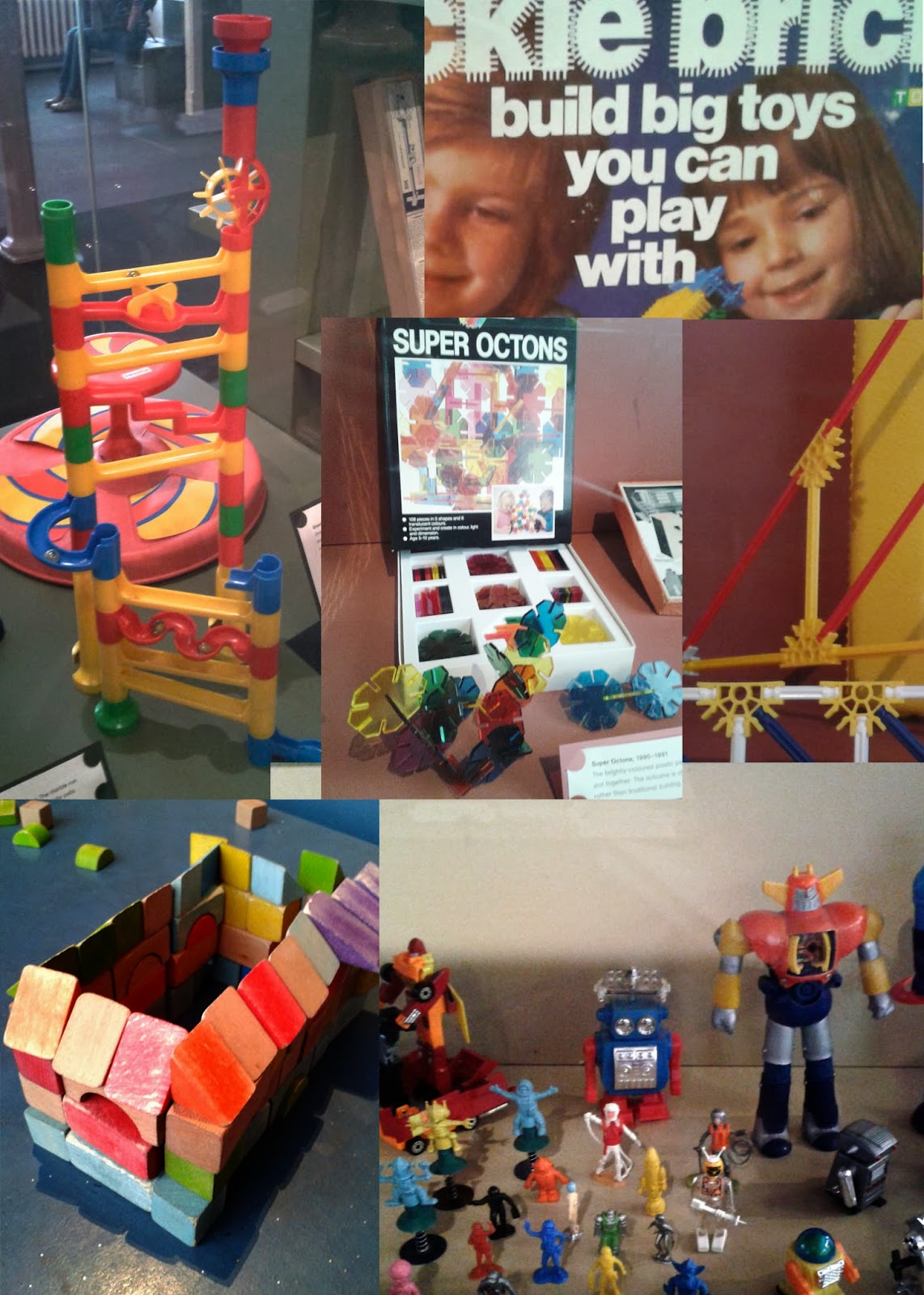
I also had good fun drawing from objects in the museum's main collection, where they have toys from across the ages. Things that really interested me were the constructive toys…linking to my box of things to physically 'play' around with, this type of toy is meant to be manipulated, taken apart and reassembled. There is a feeling of excitement and opportunity, as the toy has components that the person playing gets to decide how to put together. I also really liked the plastic character toys- robots, little people, ect- they have personality and a sense of humour due to their graphicy, humanised features that make them seem alive. 
montage of some of the objects I was drawn to in the museum collection
sketching at the museum

When I was making my paper collages last week, I used the word 'hybrid' to inspire how I put my imagery together. Looking closer at objects in the museum today however, I realised lots of toys are hybrids already, especially the construction based ones I like so much! Now I am thinking that for my photoshop (CAD) print work, it will be fun to try creating hybrids of my already hybrid-objects; taking parts of my drawings and photos and playing around with digitally collaging them together to create motifs and patterns. Lets see how it goes!